Tuesday, May 14, 2013

Visiting Cappadocia, Day Two


So, Cappadocia... Our second day and the morning following were a lot more fun, mostly because we went more for experiences rather than sightseeing. As I said in the last post, to me, Cappadocia is a one-hit wonder -- at every site, you're going to see a rock-cut something. And while it is really amazing and interesting that people had the tenacity to carve into these rocks and then live in them, at the end of the day, it's still a lot of rocks.

With that in mind, it should come as no surprise that everyone in our group agreed one of the best parts about the trip was the (free!) organic breakfast tour we went on through the delightful Kelebek Cave Hotel, which housed us for two nights. (The hotel was awesome -- I would probably come back just to stay there again and swim in the pool.) We took an open-air tractor-buggy to the owner's family farm, where we had an amazing Turkish breakfast of olives, tomatoes, menemen, cucumbers, cheese, dried apricots, strawberries, and more. We all really enjoyed this glimpse into Cappadocia's agricultural life, and the food was delicious.


We even got an up-close look at a couple of Kangal dogs, which are these huge Turkish mastiffs. As I recall, someone said this particular dog is only about a year old.


We spent the afternoon sightseeing around the area south of Goreme. We started at the seven-level Derinkuyu underground city, which was built more than 1,000 years ago by the area's Christian inhabitants as a hiding spot for when invaders swept through. Information seems to vary on the interwebs, but according to Lonely Planet, there were more than 130 underground cities in the region, and Derinkuyu had about 10,000 inhabitants.


Derinkuyu had a church, wine vats, a baptism pool, bedrooms and clever rolling stone doors, but there aren't any informational signs, so it's best to either go on a tour or hire a guide at the site. Otherwise, you'll have absolutely no idea what you're supposed to be looking at, and the site will seem like nothing more than -- wait for it -- rocks.

After Derinkuyu, we drove to the town of Sahinefendi and the archaeological excavation site of Sobessos. Although the Cappadocia tours include Sobessos, there's not a lot to the site and at the moment, it's not very well signed. The Internet tells me that it was a fourth-century Roman settlement and that excavations began in 2002, but I can't confirm that either bit is true. When compared to the rest of Turkey's ancient sites, Sobessos is a disappointment, but the drive there and beyond was lovely -- if you go, it's probably best to think of it as a pit-stop on an afternoon's road trip.


After Sobessos, we headed to Urgup for a very late lunch (or, perhaps more correctly, an early dinner). Since we were all starving, we didn't spend any time looking around, but from what I briefly saw, Urgup looked charming and probably deserved a bit more of our time. We spent the rest of our evening in Goreme, another charming town and our base. It was surprisingly quiet considering the amount of big tours we saw, but I fondly remember its mid-summer laid-back atmosphere from three summers ago. There's just something about it, some intangible quality, that I just love.

Of course, Cappadocia is famous for its hot-air balloons tours*, and I would be remiss if I didn't mention them. I went on one of the balloons three summers ago -- it was a lot of fun, but I'm going to go out on a limb here and say that watching the hot-air balloons might actually be more breathtaking. We had a spectacular view of the balloons going up in the morning from the various outdoor areas of our hotel, and our friends could even see them floating across the horizon from their room (Arch room #3). Watching the balloons, even at 6:30am, was just unforgettable and another experience that outshone ordinary sightseeing, so much so that I'm devoting another post just to photos. (Having said that, you should still totally go on a balloon ride...consider this an extra option.)

*Shortly after I wrote this post, a balloon hit another balloon during a morning ride in Cappadocia on May 20, causing the lower balloon to fall from the air, which resulted in the deaths of three Brazilian tourists and injuries to a number of the other passengers. According to the newspaper, this is the first hot-air balloon accident since 2009, which is a pretty good safety record but no doubt little consolation to the Brazilians' families or the other injured tourists. Not surprisingly, hot-air balloon bookings in Cappadocia are reportedly down 20 percent.


But having said that, I'm ending with the Goreme Open-Air Museum, arguably the region's most popular sightseeing attraction and absolutely its best, even if it does involve, yes, rocks. Even though we had to rush to the airport, we ducked in here for about 45 minutes on our last morning. There are perhaps about 12 churches and chapels that you can pop into at this UNESCO World Heritage Site, and a number of them still feature beautiful and colorful frescoes. We went around 9am this trip, and the museum was unbearably packed -- when I went three years ago, I visited late in the afternoon, and it was nearly empty. Just a little tip from me to you. :)


Pin It

Monday, May 6, 2013

Visiting Cappadocia, Day One

We had some friends visiting from Canada at the end of April, so we took them on a mini-tour around Turkey, starting with Cappadocia. I went there when I came backpacking in Turkey in 2010, and to be honest, I wasn't all that excited about a return trip -- Cappadocia is beautiful and definitely worth a visit, but it's a one-hit wonder. But no one else had been, so off we went. :)

BASIC INFO: Cappadocia is a region located in the middle of Turkey and to get there, you can either take the bus or fly into the Kayseri or Nevsehir airports. The Nevsehir airport is significantly closer, but it doesn't see a lot of flights; Kayseri is about an hour 15 minutes from Goreme, Cappadocia's main hub, but it seems to offer more options. (However, from both airports, the only option is to fly to and from Istanbul.) We rented a car at the airport since the daily rental price (TL 90) was the same amount the four of us would have paid for the shuttle to take us into Goreme -- everything in Cappadocia is really spread out, so renting a car was actually one of the best choices we made.

In terms of sightseeing, we used the group tour itineraries as our guide. There are three main on-the-ground tours around Cappadocia, organized by location -- one takes in the area around Goreme (a hike in Rose Valley, Pasabag, maybe the open-air museum), one goes to the area directly south of Goreme (a hike in Soganli Valley, Sobessos), and one goes to the area to the southwest (a hike in Ilhara Valley, Selime rock monastery). Most include a visit to one of the underground cities, where villagers used to hide when invaders were passing through. Because of the distances and few roads, it's easiest to plan a day around a small section of the map, rather than drive around in all directions trying to see the highlights.

On our first day in Cappadocia, we stuck to the sights around Goreme. We started in the small town of Cavusin, which was only about a 10-minute drive away. At street level was the modern town, but perched above it in the rocks was the old, abandoned part of town. It was fun to poke around, but there weren't any signs, so you didn't know what you were looking at.


After that, we visited the Zelve Open-Air Museum, which one of the guys at the hotel had recommended to us as a good alternative to the very crowded Goreme Open-Air Museum. But I don't think it's really comparable -- the Goreme Open-Air Museum has a lot of beautiful frescoes while the Zelve Open-Air Museum gives the region's best glimpse, I think, of what it would have been like to actually live in a rock-cut community. There's nothing left but the rocks, but with the few churches, a mosque and the mill stone, it felt the most authentic to me. That might also be because it was fairly recently inhabited -- the last residents moved out in the 1950s.


After, we went to one of my favorite spots of the trip, Pasabaglari. It was just a relatively small area of __________-shaped fairy chimneys (fill in your own word based on the photo below), but I enjoyed walking along the paths.


To be honest, I wasn't all that enthused by what we saw on the first day. It was a lot of rocks. (Clearly I was not meant to be a geologist.) It also rained most of the day -- it even hailed at one point. We did have a lovely dinner at the grill restaurant Dayinin Yeri in Avanos, though.


Pin It

Friday, April 19, 2013

Sultanahmet and the last of the tulips

On Sunday, we spent the afternoon in Sultanahmet, the historic heart of Istanbul. Our main purpose was to buy me a museum card (foreign residents are now allowed to buy the year-long pass, woohoo!), but we ended up just doing a lot of wandering around.

My Instagram photo of the Hagia Sophia

Although we went to Gulhane Park last year to see the tulips, for whatever reason, we didn't go look at the tulips at the Blue Mosque or the Hagia Sophia. So this year, we rectified that; we also explored around the Hippodrome and popped into the Archaeology Museum, but I'll save those bits for another post.

Walking along the Hippodrome, Instagram again

We started at the Hippodrome and the Blue Mosque. I hadn't actually been inside the courtyard of the Blue Mosque since my very first day in Istanbul, all the way back in July 2010. That day, some guy tried to pick me up on the street -- I tried to duck him by going into the Blue Mosque, but he said he'd wait for me at the exit, so I covered up my hot-pink shirt with a black pashmina and ran out the other side. :)

Crescent-and-star hedge...like the Turkish flag
Courtyard of the Blue Mosque


But I digress...

Street cat sitting on the weekly bazaar tables
Sultanahmet and Turkey's Anadol car


We ended the day at Gulhane Park, which was ridiculously crowded but not all that surprising as tourist season has already started in Sultanahmet.

Crowded Gulhane Park
Orange and yellow tulips in Gulhane Park


And that, most likely, is the last of my tulip posts for the year. I know, I know...say it ain't so!


Pin It

Wednesday, April 17, 2013

Yedikule Fortress and more tulips

If it's any consolation, this is my second-to-last tulip post. 

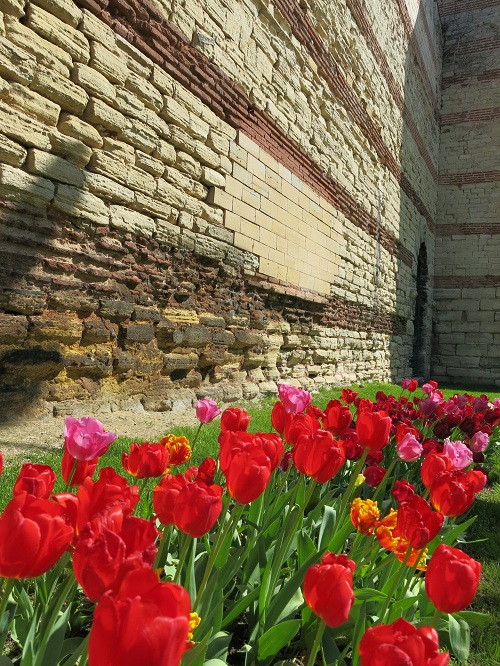
So, the Friday before last, I spent the afternoon with my Greek-American friend Eva and her family. Her mother is visiting from Greece, and she wanted to see the tulips before she heads back, so we went over to Yedikule, as I'd heard the park there had a large tulip display. We weren't completely sure of the park's name -- I'd seen it mentioned as Soğanlı Bitkiler park in a newspaper article, but that doesn't generate a lot of Google hits, and when we got there, the sign said the International Peace Garden. According to the guard there, the park has three names, and hence the confusion.


Tankers waiting in the Sea of Marmara...dear god, look at that pollution hanging over the Asian side of Istanbul!

Despite its presence in a corner created by fast-moving roads, the park is gorgeous. The location is prime: it lies along the old city walls and across the way from the Sea of Marmara and a different park of pathways and grassy areas that hugs the shoreline. Soğanlı Bitkiler/International Peace Garden park sits along the Land Walls of Theodosius, a second set of city walls built by Emperor Theodosius II in the 400s to protect the burgeoning city of Constantinople. The walls stretched from here, on the Sea of Marmara, to the Golden Horn, enclosing the city, which at that time was basically limited to the peninsula.


By far the coolest thing about Istanbul is its somewhat forgotten, old historic bits like this -- I dig the fact that I live in a city with a castle and city walls that are just sort of there. Visitors swarm the monuments in the old city like the Hagia Sophia and the Blue Mosque, but the Yedikule Fortress and the Land Walls of Theodosius mostly just sit there unbothered and observing. 


Although the park is relatively large, it's nothing compared to the length of the city walls. At the end of the park, you can more or less follow the line of walls and reach the Golden Gate (visible off in the distance) and the entrance to Yedikule Fortress. The fortress was built in the 1450s by conquering sultan Mehmet II, who smartly used the existing wall structure and just had three more towers built, creating an enclosed fortification. But alas, Yedikule Fortress was mostly used as a prison and execution site.

The fortress was unexpectedly closed when we were there, so we couldn't go in. [Huh, when we were there,  the sign at the entry said Yedikule Fortress would be closed for two days, but a note on this recent newspaper article says it will be closed until further notice.] I gather that the big attraction is the view and the fact that you're climbing on something that's 1600 years old. You can still climb up on the walls at other spots, though.

From there, we walked back to Eva's neighborhood, passing some lovely, if dilapidated, traditional wood houses along the way.


Pin It

Tuesday, April 16, 2013

Yildiz Park and tulips

Yes, yes, it's yet another post about tulips, though it's awfully hard to write about enjoying the outdoors right now as our weather has turned rainy and cold. Damn you, fickle spring!


So, last weekend, we headed over to Yildiz Park in Besiktas for a wander among the flowers. We live fairly close to the park, and it seemed like an easy excursion on a day we didn't feel like doing much else.

And because we wanted easy, we made the wise decision to start at the top on Palanga Street. The park slopes down dramatically to the waterfront, and I imagine it would have been a tiring climb if we'd gone the other direction. (If you go, start at the top, really -- trust me on this.)

When the Ottomans were in power, Yildiz Park served as an imperial garden, first for Ciragan Palace along the Bosporus and then later for Sultan Abdulhamid II's newly constructed Yildiz palace within the park grounds. (In Turkish, the name actually translates to Yildiz Chalet, and according to Lonely Planet, it was the last sultan's palace to be built in Istanbul, in the late 1800s.)


We never actually got a look at Yildiz palace -- it's hidden behind a massive wall and foliage, and we decided not to pay to go in. But the park has a number of other lovely Ottoman buildings, and we wandered into the 1870-built Malta Kosku, where they were serving an open-to-the-public brunch. Fun fact -- After Sultan Abdulhamid II deposed his brother Murat V in 1876, he imprisoned him and his family here.

The park was far more quiet than I expected, especially when compared to Emirgan Park, although perhaps that was due to the fact that it was overcast and a wee bit chilly the day we went. But at times, despite the cars throughout the park, I almost felt like I was wandering through the woods.


At some points, because of the slope, we caught glimpses of the Bosporus and Sultanahmet.


When we were in Emirgan Park a couple of weeks ago, Cagatay and I were reminiscing about our trip to Holland last year, and we speculated on whether anyone responsible for the tulip displays in Istanbul had gone there to study Keukenhof Gardens, arguably the world's premier tulip garden. And now, after strolling through Yildiz Park, I believe the answer to that question is yes -- at the southwest exit, there's a river of flowers that looks remarkably like the one in Holland. :)


Pin It

Saturday, April 6, 2013

An Istanbul football game

As in almost every country in the world except for the US, soccer/football is a passion here in Turkey. I'd been jonesing to go to a game pretty much from the first moment I got here, but it never happened -- mostly because Cagatay is perpetually disappointed by the play of his team, Besiktas. (Of course, everyone here has a team that they're fiercely loyal to. Most towns have just one team, which usually sports the name of the city -- like Trabzonspor or Gaziantepspor -- but Istanbul has a bunch of teams, the most popular of which are Galatasaray, Fenerbahce and Besiktas. Last year, if you remember, we got caught outside in the mayhem following the Fenerbahce-Galatasaray championship game. But I digress...)

So, finally, about a week and a half ago, we went to a game, after Cagatay's friend organized a big group to go see the Turkey-Hungary match at Fenerbahce's stadium, part of the 2014 World Cup qualifiers. We had great seats on the upper level, but sadly, the game itself was not that exciting -- it was pouring rain and neither team was able to do much with the ball. Play mostly hovered in the midfield, and the game ended 1-1, which means Turkey probably won't qualify for the 2014 World Cup.

This outcome was not all that surprising as Turkey hasn't qualified for the World Cup in a decade. But what did surprise me was the enthusiasm of the fans, or lack of. People cheered, don't get me wrong, but usually you see crazy passion, and it's chaos with fans going nuts and throwing flares and other projectiles onto the field. Take the Galatasaray-Real Madrid match that took place in Spain this week -- a bunch of fans got into a brutal fight with the police while another group in Istanbul tried to attack a TV station supposedly because the commentators picked Real Madrid to win. Passionate, no? But it wasn't like that at this game, it was just civilized cheering...and what can I say, I wanted to see a little of that famous energy. :)


Pin It

Friday, April 5, 2013

Goztepe Park and tulips

Yes, another tulip post. I'm sure this is how my hubby secretly feels, despite the fact that last weekend, I managed to convince him that he really wanted to go see the flowers at Goztepe Park on the Asian side. :)


I'd never been over to Goztepe Park before, and after seeing how impressive it is, I'm a little sad that we don't live closer so that we could enjoy it more often. It might be the nicest park in the city. One chunk of it is a rose garden (which they were tearing up when we were there) while another chunk of it is your average city park with benches and winding pathways. This section had most of the tulips, but of course, those only last about a month out of the entire year. Then, farther on as you walk toward Bagdat Street, the park changes -- most of the flower beds give way to an (English-style?) hedge garden, and there's a huge pirate ship for kids. They're also in the process of building tennis courts and a fountain.


Anyway, to the tulips...


Most of the tulips I've seen in Istanbul have been the full-bodied ones, as in the photos above. I think it's fair to say that this is the shape most people think of when they think of tulips. But Goztepe Park also had some of the pointed tulips that are most commonly associated with the Ottomans -- and these are the type of tulips I most often think of when I think of Istanbul. While they're not all that common in gardens, you see the pointed tulip used everywhere in design, from a motif on historic Ottoman tiles to Istanbul's 2020 Olympic logo.


Across the street from the garden we spotted a beautiful traditional-style Istanbul house -- a konak. "The wooden houses of Istanbul, built in large part in the second half of the 19th century and the early years of the 20th century, are of two major types: the konak and the row house. The konak, the older building form, is a single family town house surrounded by a garden. These gardens form an essential part of the spatial and architectural programme." There aren't a lot of these types of buildings left, which is a shame as they're so lovely.


Pin It