Showing posts with label This Week in Turkey. Show all posts

Sunday, July 14, 2013

What's Happening with Gezi Park Now?

Hello friends! It’s been awhile since I’ve blogged, and that’s because the last six weeks have been a flurry of activity – we spent a week in Ankara wrapping up my hubby’s green-card application and when we returned to Istanbul, it was time to sell our furniture and pack our things in preparation for a June 1 move-out date. Since then, we’ve been traveling around Turkey, visiting various relatives, and Internet in some places has been scarce.

So it’s a little late, but I wanted to talk about Gezi Park again. The international media has moved on to Egypt (a coup being ironically a godsend for Prime Minister Tayyip Erdogan) and the national television media from the beginning has barely covered the protests, so admittedly, it’s been a little hard to know what’s going on. Now that we’re not in Istanbul, it’s like the whole thing never happened – aside from the occasional graffiti, there are no signs that anything in this country is amiss. It’s just…weird.

The biggest development in recent days is that Gezi Park was reopened to the public. I believe it is generally open now, though we have not been in Istanbul since before then, so I can't be sure. On our last day in the city, we passed by Taksim Square and could see construction workers busily beautifying the park. Word is that the municipality planted flowers and trees, but the biggest change that I could see (from the outside – no one was allowed in at that point) was that they created a grassy slope on one side, a definite improvement giving better access to Gezi Park. 


But it’s also very weird – there’s that word again. I mean, the prime minister wanted (wants?) to rebuild these old military barracks on the site and not once has he, arguably the sole holder of any real power in this country, acknowledged the validity of the protesters’ concerns. In fact, he continues to lecture on how very wrong everyone else has been. And thus, the government chose to improve the park? I almost feel like I’m living in Alice in Wonderland – it’s hard to explain, but it’s like they’re trying to confuse the issue, acting as if they always meant to improve the park, and the protests were just these little anarchistic acts perpetrated by marginal groups. But I was there, and that’s not what happened. An estimated 2.5 million people across Turkey, in something like 80 cities, came out in support of the Gezi Park protests, and they came out despite the tear gas and water cannons and police blockades. They’ve been ordinary people, and they weren’t bused in/fed/coerced to show up as was seen with the AKP’s recent rallies.

Things had seemingly settled down at the end of May, after the police cleared the park and surrounding area. As I mentioned before, everyone felt really angry, but without being able to gather in Taksim, the protests seemed to lose steam. There was never one group organizing the protests, so there was no one to re-organize the protests. I was in Taksim at the end of May, on two subsequent days, and there wasn’t a lot going on. The first night, June 25, the police had physically ringed the monument and Taksim Square, presumably to block people from putting up banners on the monument and from continuing the Standing Man protests in the square. The friend I was with that night wrote an interesting column about how protests like this force the police into "dilemma actions" -- in other words, into absurdity.


But other than that, people were going about their business; there had been a march an hour or so earlier, and some of the marchers were hanging around, but that was it.


The next day, I was there in the afternoon, and although there was still a large police presence, nothing was happening. The only form of protest I could see was a few “standing men” at the end of the square, looking up at the large portrait of Ataturk hanging down from the cultural center.


 But from what I can tell on Facebook – my biggest news source on Gezi Park – people have regrouped, and there have been protests every day for at least the last week, if not longer. And the police have responded with tear gas and water cannons. The Istanbul Tear Gas Festival continues! Last night's protest apparently stemmed from a midnight bill (ahh, another midnight bill) passed by parliament "which curbed the supervision of the Chamber of Architects and Engineers (TMMOB) in all urban projects, giving full authority to the Environment and Urban Planning Ministry," according to one of the local papers. There was also a protest two nights ago in the southeastern city of Hatay as an estimated 3,000 people gathered there to commemorate 19-year-old Ali İsmail Korkmaz, one of the reported five to have died in the protests. He was beaten by unknown assailants in Eskisehir and later sent home by a doctor – the next morning, he was unable to speak, and he passed away after being in a coma for 33 days. The footage of the attack has apparently disappeared. And as with all of the public gatherings for those who have died in the protests, the police responded with the usual force, refusing to allow people to express their grief and commemorate the dead.

The story of Ali Korkmaz brings up one of the most disturbing things about the Gezi Park protests, and that is the violence that has been perpetrated against the protesters, or anyone seen as not supporting the AKP. The horrible stories spread around by government officials of protesters assaulting women in headscarves, cavorting in a mosque with alcohol or violently attacking  the police have mostly been proven untrue. Protesters have thrown rocks, certainly, but it hasn't been proven that they were the wielders of Molotov cocktails, and anyway, most people believe those men were undercover police. But acts of violence against protesters? The tear gas and water cannons are one thing, but protesters are also being physically attacked by those who don't support the cause. I have read about some awful things, none of which have been disproved. In my last post, I mentioned how participants in a Gezi Park group meeting in a park were attacked, and the attack was allegedly led by the neighborhood's headman. Last night, shop owners threatened protesters with wood batons. My friend has told me of watching from her window protesters being attacked with rocks. I also read the story of a friend's friend on Facebook -- a less reputable source, of course -- who attended a press event for another urban project as an accredited journalist, was harassed by the project's supporters, and then had her press pass circulated on Twitter with the allegation that she is a foreign spy. There's also video footage of a man chasing people with a machete and then kicking a woman -- but the police ultimately let him go, and he fled to Morocco.


What the hell is going on here? And where is the international media? As usual, stay tuned...I still can't say where this is all going.

Pin It

Friday, June 21, 2013

What's Happening in Turkey?

So, it turns out that I haven't written a blog post, on Gezi Park or anything else, in just over two weeks. I'm not quite sure how that happened -- I suppose I could say that we've just returned from a five-day trip to Ankara and we're moving out of our apartment in nine days, but that would be an excuse. If I'm being honest with myself, the real reason is that I just feel so disappointed with everything that's been happening in Turkey. I could spend hours analyzing  the prime minister's divisive rhetoric or the government's lies (and don't be fooled, they are lying), but I got to a point where I felt like, Why bother? And then it just seemed silly to blog about other, mundane things. If nothing else, the protests in Turkey have been all-consuming; I swear, it's all anybody can talk or think about.

At the same time, there's been a disturbing lack of information about what's been happening in Turkey's cities. While the domestic TV news channels are now reporting on the various protests and everything related to them, the footage usually covers what happened about 18 to 24 hours before. It's been really hard to get a handle on what's happening at the moment, and even Twitter and Facebook doesn't always provide the answers. It turns out that there's something very disorienting about living in a city and not actually knowing what's going on there.

To be honest, I'm not sure where the Gezi Park protests are headed next. The issue of the park's development, which is what sparked this whole thing, has been more or less resolved -- a court has suspended the building project and should the government win on appeal, they have pledged to hold a referendum to determine Gezi Park's future. And while not everyone believes that the government intends to fairly follow this outlined process, there's nothing more to be done about the park right now. So technically, the protests should be over, but the protests are no longer just about Gezi Park.

I actually thought the whole thing was over after the police surprised the protesters with an attack in Taksim Square on Saturday. People were angry, certainly, but this time, the police took a much stronger stand in keeping protesters out of the park and square, and that action -- combined with later throwing tear gas into nearby hotels -- seemed like the final blow. But I was wrong -- the protesters have not given up. The "standing man" protest -- where one just stands silently in a quiet act of civil disobedience -- has caught on, and groups of people have begun meeting in parks around the city to discuss their next steps.

I sincerely hope that the protesters do not give up. I have stopped deliberately going out to protest areas as I fully believe that this is a Turkish issue that has to be solved by the Turkish people, and my presence as a foreigner is irrelevant. (It may even be harmful, considering that the government has partially blamed the demonstrations on foreign agents.) But if the Turks stop protesting, I believe that the situation here will be worse than before, and that instead of expanding civil engagement, the Gezi Park protests will have resulted in Turkey becoming a more repressive country. And that thought just makes me really, really sad. People have died for this.

Yes, Gezi Park has seemingly been saved. But what is being lost? Even more journalists have been arrested, the few TV channels that showed the initial protests have been fined for "harming the physical, moral and mental development of children and young people," the Health Ministry wants to investigate the doctors who helped the wounded, lawyers have been detained, and there are reports that the government is drafting some kind of bill on the use of social media (although the govt is saying now that the bill will only affect "crimes over the Internet," whatever that actually means). Various AKP ministers have also said that the government plans to strengthen the power of the police force and will bring out the military if necessary. With this kind of rhetoric, is it that much of a surprise that a group peacefully meeting in one of Istanbul's parks was violently attacked (by civilians of a different political viewpoint) last night? Instead of offering conciliatory messages, the government has instead decided to display its strength, and I think it's fair to say that they have no intention of backing down on their general policies. Half the country apparently agrees with them, and half don't. So the question becomes, what will the other 50 percent do? As we near the end of week four of the Gezi Park protests, I still think the answer is that only time will tell.

Pin It

Thursday, June 6, 2013

A Walk Around Taksim Square

Yesterday, we went down to Taksim Square and Gezi Park to check out what was going on. While it's a little harder for me to keep up with events considering my Turkish is only intermediate, I think it's fair to say that if you judged the situation here just by the news, you'd think that the protests were over and everything had returned completely back to normal. But as we saw yesterday, that is definitely not the case... The violence has ended, at least in Istanbul, but the large-scale protests continue.

Part of the reason for this, in my opinion, is that the government has not backed down an inch. What they are thinking, I cannot say, but it's undeniable that the protests became what they are because of the police response and the government's aggressive and dismissive statements about the protesters and their motives. So far, three people have been killed and over 4,000 injured. The protesters come from all walks of Turkish life, but government officials have called them drunks, "looters, marginal and members of illegal organizations" and "foreign enemies who envy Turkey." While President Gul and deputy prime minister Bulent Arinc have made conciliatory statements in recent days -- Arinc said two days ago that he would meet with members of the Taksim Platform (the group originally campaigning to save the park) and suggested that a referendum might be held -- the prime minister went on a diplomatic trip to North Africa, which many people saw as a sign that he didn't consider the issue worthy of his attention or time.  Throughout it all and as recently as today, the prime minister has insisted that the Topcu Barracks will be rebuit in Gezi Park; a few days ago, he also added that they would be building a mosque in another part of Taksim Square. "'A mosque will be built in Taksim,' said Erdogan adding that he did not have to receive permission from the main opposition leader or a 'few marauders' for the projects," according to a recent newspaper report. Even though the Turkish stock market and the Turkish lira have taken a hit, I think it's fair to say the message has not gotten through. :(

So, no surprise, people are still out at Taksim and in Gezi Park "occupying."

We first walked down Istiklal Street to check out the graffiti and damage. There were a number of store windows broken, and almost all of the ATM machines we saw had been destroyed.


There was also a TON of graffiti. Some of it was quite funny -- in the photo below, the one to the right that shows part of a red ATM machine, the top piece of graffiti reads, "We will find you, Joffrey the blond! The brave ones are on their way from Winterfell," for all you Game of Thrones fans.


The graffiti showing the man's face portrays Prime Minister Tayyip Erdogan in a variety of poses. "Kimyasal Tayyip" means "Chemical Tayyip." I assume the penguins are there because over the weekend, CNN Turkey aired a documentary on penguins instead of covering the violent clashes between the protesters and the police, and the penguins have become a bit of a symbol of the local news media's lack of coverage here (which is a whole other story).

There had also been a multi-day public sector strike going on, and while we were there, we saw a number of groups marching.


But despite all the damage and the continued peaceful protests, I was also surprised by how easily everyone was going about their regular business -- while things are not back to normal in the sense that this is still a burning issue, people have cheerfully rebounded from the chaos that was Friday and Saturday. While some people gave away free face masks during the height of the violence (and people continue to give away free food and drinks), we saw some entrepreneurial souls selling cotton candy, drinks, and V is for Vendetta and gas masks around Istiklal.

After our stroll down Istiklal, we walked the perimeter of Taksim Square. There are still a number of damaged and overturned vehicles blocking the roads up to the square, and they've seemingly become photo ops for gawkers like ourselves. There were also a couple of destroyed city buses next to Gezi Park, and those have seemingly turned into hangout areas for local teenagers, teenagers who I suspect aren't much interested in the actual protests. :)


Our last stop was Gezi Park. I was actually shocked by how many people were in the park -- it was absolutely packed, and there were still a lot of tents up, which suggests that there is a permanent group camped out there.


In the area where the trees were taken down, some people had planted a small garden. Some of the little plants had an IV bag attached.


So, that's what's happening here. I'm not sure where or how it will end...stay tuned. But I hope there can be some actual reconciliation on the issue of the park. Because just look at this city -- so much concrete, so few trees...


Pin It

Tuesday, June 4, 2013

All You Need to Know About Gezi Park -- Christiane Amanpour's interview with the AKP

The proposed reconstruction of the Topcu Barracks*
While the Gezi Park protests may have started over some trees, they have grown to encompass a wide-range of issues, mostly stemming from concerns that Prime Minister Tayyip Erdogan's AKP government has grown increasingly autocratic. There have been a number of laws and rules passed recently that suggest the government is trying to push a more religious lifestyle, while at the same time, a number of large city projects have begun (or continue) seemingly without public input. In short, the secular citizens of Turkey feel that they their country is changing and they have no say in the matter.

I could link to a thousand things to support various points and arguments, but if you want to understand the basic situation in Istanbul right now, and how the two sides do not see eye-to-eye, here's what you need to watch: Christiane Amanpour's 8-minute interview with Mevlut Cavusoglu, an AKP guy from Antalya who is currently with the prime minister in Morocco. I'll even provide a guide to go along with his statements.

Minute 0:37: Cavusoglu says, "Well, first of all, I have to correct the fake information, that building a shopping mall has never been considered here in Taksim Square. What is considered is the pedestrian way and the putting the car traffic under the tunnel, and enlarging the Taksim Square. Only old military barrack is considered to rebuilt, the old military barrack." The grammar isn't perfect, but he's referring to the defense recently put forth that the trees were only cut down to widen the sidewalk, and that the only construction that will happen in Taksim Square will be the reconstruction of former military barracks on the site. While I won't call his statement an outright lie -- although according to multiple local newspapers, Erdogan himself confirmed that the reconstructed barracks "are to be converted into a shopping mall and might serve as a residence with social facilities" in a speech on April 29 -- Cavusoglu is certainly obfuscating the issue. First of all, the mall (or whatever else) was going to be in the barracks -- it's not a questions of the barracks vs the mall. But let's give him the benefit of the doubt and say they never intended to build a mall in the barracks. Fine, no mall. Maybe they intend to create a hotel. The fact is, IT DOESN'T MATTER. It's the barracks that are the issue because no matter what the barracks are used for, their construction destroys the park -- and the park is the point, not the mall.

Minute 1:14: Cavusoglu says,"And this project was actually supported by all the political parties in the city council, and it was adopted unanimously by the city council." This is an absolute simplification of a much more complicated approval process, one that was met with controversy. The project was first approved by the municipality, but the decision was later nullified by another board over concerns about the park. Then that decision was overruled by High Council for Protection of Cultural and Natural Assets in February or March (depending on your source). "Professor Betul Tanbay from the [Taksim] platform told Sunday's Zaman that many people feel betrayed by the lack of consultation and the secrecy with which the plans were passed through official channels," according to an article published in February.

Minute 4:04: Cavusoglu says, "We have been elected by the people, and in last election, more than 50 percent of the population supported us." Nitpicky perhaps, but in the 2011 elections, the AKP won 49.83 percent of the popular vote. But I mention this because I think his statement is meant to suggest that a vast majority of the Turkish people support the AKP and their policies, and it simply isn't true. Half the country supports their general policies and half don't.

Minute 5:45: Starting at minute 5, you can start to hear Christiane Amanpour's frustration with Mevlut Cavusoglu as he continues to talk and won't let her speak. Finally, Amanpour says, "Sir...Sir, please, this is an interview, sir. I need to ask you some questions...I need to ask you some questions, this is an interview, sir, not a speech. It involves me asking you some questions." Along with "Do whatever you want to do, but we've made our decision," Erdogan's statement last Wednesday, Cavusoglu's attitude during this interview is, for me, the personification of the government's attitude to both the people and the recent protests. Imagine how they must listen to their citizens!

Min 6:58: Cavusoglu says, "Regarding the second group [the radical and marginal groups], we cannot negotiate with the terrorists and the marginals." This actually made me laugh out loud since the government did, in fact, negotiate with the Kurdistan Workers' Party [PKK] this spring, allowing the members of the terrorist group to lay down their arms and leave Turkey without any sort of punishment. During the PKK's 30-year clash with the Turkish government, some 40,000 people were killed.

*The rendering of the proposed reconstruction of the Topcu Barracks comes from a local newspaper's website. The barracks surround what is now Gezi Park. A version of this image was used during an interview  Prime Minister Erdogan gave over the weekend; in the video, it appears just after 1:25:24.


Pin It

Saturday, June 1, 2013

The Sounds of Protest

I thought everything in Istanbul would be calming down since the riot police left Taksim Square late this afternoon, allowing the thousands of protesters to gather unimpeded in the square. But unfortunately, we're hearing on Twitter that the police have used (are still using?) water cannons and tear gas against protesters this evening in Besiktas. Which happens to be the municipality we live in, but that's cool. :(  Social networks indicate that protesters are heading to Besiktas now and that the police are trying to stop them from getting there. The prime minister's Istanbul office is over there (it was right across from where we were standing when we encountered the CHP parade this afternoon, in fact), and I am not sure if that has anything to do with it, either really or as an excuse. I think it's fair to say we can expect another day of chaos tomorrow.

We're safe and sound inside our apartment, and everything is fine in our immediate neighborhood. But I can hear the sounds of protest quite clearly -- honking horns, whistles and the banging of pots. Apparently it's what Turks do to show solidarity. Listen in:


These were the kinds of noises that woke me up in the middle of the night last night. It freaked me out in the seconds before I could figure out what was going on and that we weren't actually being attacked in our beds. :(

Pin It

This Week in Turkey: Protests in Istanbul's Taksim Square

As I'm sure most people have heard, Istanbul is going CRAZY right now. The police have just left Taksim Square, allowing thousands of protesters to pour in -- from what we can see on TV right now, Taksim is absolutely packed, with what looks like thousands and thousands of people. Hooray, victory for the people! Hahahaha, probably not -- although the prime minister today admitted that riot police have used excessive force, he also said that the controversial barracks project that started all of this will proceed.

We've just gotten back home, but we never actually made it to Taksim today. When we left the house this morning, we took the metro as far as we could, to Sisli-Mecidiyekoy (two stops from Taksim Square), and then we walked. At first, all was peaceful, but as we neared the Osmanbey stop, the crowd swelled and an advance-retreat with the riot police began. Everyone would be walking toward Taksim and then the police would fire pepper gas at us -- Cagatay and I weren't really all that near the front of the crowd, but that pepper gas was powerful stuff, making our eyes, noses and throats burn unbearably. At one point, a man gave us face masks.


Fleeing from the pepper gas, the crowd would back up a couple of blocks, but then, within a few minutes, everyone would advance again and then it would be more pepper gas, and the cycle would begin again. We got as far as Harbiye, perhaps five to seven minutes on foot from Taksim, before giving up and heading into Nisantasi to find something to eat. Because by that point, we could see the front of the crowd and the police were letting off pepper gas over and over again, creating these huge plumes of smoke -- and it was pretty alarming to suddenly have a wall of people running back towards us.

Later, as we walked through eerily silent neighborhoods, past all the closed shops and along traffic-less streets -- it was sort of like the Muslim Rapture had gone down -- we ended up running into the huge CHP parade heading for Taksim. We thought about joining them, but we didn't know what was happening in Taksim and we didn't want to deal with pepper gas again or water cannons, so instead, we headed home.


This whole situation began at the beginning of the week when people gathered in Gezi Park -- located on one side of historic Taksim Square -- to protest the destruction of the park's trees as part of a project to reconstruct an old military barracks on the site that will apparently serve as a mall and residences. As I understand it, the protests started because some of the trees on the edges of the park had been felled, which made people believe that construction on the project had begun. Yesterday, Istanbul's governor and mayor held a press conference and denied that there were any plans to build a mall there; they said that they were just widening the sidewalks, but there have been rumors about the planned use of the barracks for months and I think it's fair to say that comments from other leaders have confirmed this.

Although the police had entered the park in the mornings to try and evict the protesters (one morning they burned their tents), for the most part, things were peaceful at Gezi Park. From photos I saw on Facebook and Instagram, people were kind of just hanging out. I was in Taksim on Thursday afternoon, coming home from an outing with a friend, and I was so worn out from the sun that I forgot all about what was going on in the park, which I was about 30 steps from. That's how normal things were.

But on Friday, everything changed and the riot police just went nuts on the protesters. You've probably seen the videos on TV. We had just entered the metro, on our way to Taksim, when we heard that the Taksim station was closed -- in retrospect, it was probably a good thing as we would have walked right into tear gas and water cannons. Things were pretty normal in our neighborhood except that in the middle of the night, a bunch of people took to the streets in solidarity -- I woke up terrified around 2:30am to people yelling outside and banging pots.

Anyway, more on this later...


Pin It

Sunday, March 24, 2013

Nevruz Cease-fire

It's officially spring, kids. Regardless of the weather, March 21 marks the beginning of the season each year, and in Turkey, it's also the date of Nevruz, the Kurdish New Year. Nevruz is an exclusively Kurdish holiday in this country, and it's generally associated with protests and violence. As this year's State Department security warning said, "Historically, members of the Kurdistan Workers' Party (PKK) have used these celebrations to incite violence in order to provoke a response from Turkish authorities." For a long time, Nevruz celebrations were simply banned, and then last year, there was a row over what date the celebrations would be held, and the celebrations turned violent.

But this year, Nevruz ended up being a monumental day in Turkey, as the head of the PKK, Abdullah Ocalan, called for a cease-fire and told his armed forces to withdraw from the country -- he said that it was time to exchange guns for politics and begin a "democratic struggle." Ocalan has been in jail since 1999, and his statement was read out in Kurdish and Turkish during the Nevruz celebrations in the southeastern city of Diyarbakir.

The reason why this cease-fire is so monumental is that Turkey has a "Kurdish problem." It's a complicated issue -- I don't pretend to completely understand the situation, but I'll do my best to explain. It's an incredibly politically and emotionally charged issue, and Turks hold passionate views on the topic.

The short version is that after the Turkish Republic was founded in 1923, the leadership wanted Turkey to be Turkish and did not really permit other expressions of identity/ethnicity. However, Turkey has a significant Kurdish population (the estimations differ but it's somewhere between 12 million and 25 million of Turkey's 75 million citizens) that lives mainly in the southeast. Through oppression and lack of economic development, the government tried to assimilate the Kurds into the mainstream (and thus, snuff out their culture). As a result of all this, a terrorist group (the aforementioned PKK) was formed in the 1970s and began violent attacks in the 1980s to fight for Kurdish rights and independence. Since then, some 40,000 people have been killed in the conflict. In recent years, the government has been holding secret talks with Ocalan, trying to come up with a solution. The cease-fire was not a surprise -- there had been reports about it at least a week prior -- and the conditions (lay down arms/leave the country) mirror reports in the last year of what the government's conditions were for resolution.

So hooray, peace and victory! Hahahaha -- just kidding. There doesn't seem to be a lot of  celebration -- instead, the cease-fire has created much controversy, criticism, questions and highly charged emotion. [Update: I saw a number of "hooray, victory!" columns in Sunday's paper, though some of that has already given way to discussions about Israel's apology over the Mavi Marmara incident.]

It's important to note the government has not exactly been heroes in this. In general, the current government has gone aggressively after people, including politicians, journalists and military members, who it sees as critics or threats. Discussing the validity of those trials is a whole other (highly controversial) subject, so I won't go there. Let's just say that in this specific situation, "blaming the Kurds, who were identified with terrorism or political dissent by the majority of Turks, [enabled] Ankara to justify policies that often do not discriminate between armed guerillas and disgruntled civilians," writes Gabriel Mitchell in A "Kurdish Reset": Erdogan's Last Chance? In other words, there have been a number of people arguably unfairly jailed for not towing the party line.

A month ago, one newspaper published the minutes of a secret parliamentary visit to Ocalan, and the prime minister accused the paper of acting against the national interest of the country -- which then led to (more) discussions about press freedom (or the lack of) in Turkey, and the firing/quitting of a prominent journalist. The leader of the main opposition party is now saying that no one knows what Prime Minister Erdogan and Ocalan have agreed to. Reading between the lines, there seems to be concern that the PKK and Ocalan himself, a man who has been called a baby-killer, are being legitimized as a player in the democratic process through an undemocratic, secret process (and that the violence and deaths of the last 30 years are sort of being glossed over). This is especially important as Turkey is attempting to write a new constitution that will shape the future of the country -- and, as one columnist wrote, "there is also concern that peace is [being] used as a bargaining chip to support Prime Minister Erdogan's presidential ambitions."

Another concern, again mostly reading between the lines, seems to be that the cease-fire is actually the first step in fracturing Turkey instead of heralding the "building of a 'new Turkey'." There were no Turkish flags at the event in Diyarbakir, which made a lot of people angry -- and if you watch the video, you'll see a number of red-green-yellow Kurdish flags and plenty of yellow flags featuring Ocalan's portrait. Not surprisingly, the nationalists went crazy.

This is only the beginning, and I have no doubt that there will be a lot written about the cease-fire in the coming days, weeks and months. I hope for my part that I have done it some justice in the explanation.

Pin It

Thursday, February 14, 2013

The Very Controversial Turkish Airlines

Flying Turkish Airlines is generally a good thing -- it's been named the best airline in Europe two years running, you still get free food, and the check-in agents never seem to care if your baggage is a few pounds over the limit. You can also fly directly from Istanbul to New York and Houston (among other places), lessening the jet lag on trips to the US -- when I fly American from here to Dallas, I usually have to go through London, and with the schedule and time differences, it makes for a hard adjustment. Over the last decade, Turkish Airlines has been expanding at a rapid pace, adding new destinations all the time, and it seems to be doing well -- it's a nice airline with good customer service. But lately, politicians have been interfering with airline decisions, and it's stirring up loads of controversy here in Turkey.

The problem stems from the fact that the government owns approximately 49 percent of Turkish Airlines, while the majority 51 percent is public. The current government, headed by the Justice and Development Party (AKP), is pretty powerful -- they're also pretty conservative, and their efforts to make the airline more conservative is not going over well.

Before I get into the details, let me say that one of the things I've noticed about Turkey, especially from my time working at a conservative newspaper here, is that there seems to be a big misunderstanding about what "democracy" means. One reason that the current government is so powerful is that Turkey has just emerged from a coup-filled period -- about every ten years, starting in 1960 and ending in 1997, there was a coup, and each time, it totally shook up society. I've heard this cited as a reason why for Turks personal relationships are more important than rules or contracts. The AKP came into power in 2002, and things in Turkey have been stable since then -- more importantly, the economy has improved. One of the AKP's big promises is that they're going to bring democracy to Turkey, in the form of bringing the coup perpetrators to trial, writing a new constitution, etc. For a long time, for example, women were not allowed to attend university wearing a headscarf -- under the AKP, this has been lifted, and it's a good thing. Democracy means everyone gets to wear what they like...or drink what they like...or say what they like...or practice whatever religion they like in whatever way they choose.  But it turns out that the AKP's democracy often only means tolerance for their more conservative way of life. There's a real effort right now to make the population more conservative through legislation, lawsuits and pressure -- and this is where THY comes in.

[Now, don't get me wrong -- I think we see the same warped idea of democracy in the U.S. with the various attempts to legislate morality. However, I think it's more evident here in Turkey as the new conservative powers and the old secular regime battle it out, and it's going to determine the kind of country Turkey is to become.]

In December, the prime minister, Recep Tayyip Erdogan, began criticizing the popular Turkish soap opera, Muhtesem Yuzyil (Magnificent Century), a Tudors-like show about Suleiman the Magnificent and palace intrigue. (It's apparently broadcast in 43 countries, and I know it's really popular in Middle Eastern countries, drawing loads of Arab tourists to Istanbul -- but of course, in Turkey, it's broadcast in Turkish, so unfortunately, I can't understand it.)  It's a soap opera so it's very dramatic (I hear), but Erdogan believes the show humiliates Suleiman (and Turkish values) by showing him as debauched. An AKP deputy has submitted a parliamentary petition to get the show banned, and as a result of Erdogan's comments, Turkish Airlines dropped the show from its planned in-flight entertainment. According to the Daily Hurriyet, a THY official said, "We were about to start screening the show, but we changed our minds following the prime minister's negative opinions."

Now, in the last week or so, some awful, conservative designs for the new THY flight attendants' uniforms were leaked, and reports emerged that THY intends to stop serving alcohol on domestic flights. Photos of the uniforms, designed by Dilek Hanif, were leaked on Twitter last week -- two of the women are wearing robe-coats, which in my opinion look kind of religious, and generally the cloth looks heavy and uncomfortable. After the uproar, THY rushed to say that they were still working on the designs and released other photos, and in those, the women are co, vered from neck to foot. Many people see these proposed uniforms as an effort to expand conservatism, even if it makes working on an airplane more difficult.

The alleged new alcohol policy is a little more confusing. According to the Daily Hurriyet, THY has 36 domestic routes, and supposedly, on domestic flights, THY was only serving alcohol to business class passengers. But 20 of these routes aren't separated into classes, so they were really only serving alcohol on 16 routes, and now, because of lack of demand, they will only serve alcohol on five or six routes. (One story included Izmir, the other didn't.) The five definite routes are either to big cities (Istanbul and Ankara) or vacation destinations (Antalya, Bodrum, and Dalaman). Frankly, low demand strikes me an odd reason. Food, I would understand -- it spoils and goes to waste. But that isn't the case with alcohol. Why couldn't THY just use it on another flight?

THY also doesn't serve alcohol on international routes to certain destinations (Iran, Saudi Arabia, etc) and reportedly, passengers have asked for alcoholic drinks on flights and not been served, with the crew saying someone had forgotten to load it. But the confusing part came today -- a Daily Hurriyet article said that THY confirmed they only provide alcoholic beverages on certain routes due to "fewer business class passengers and lack of demand on other routes," while a Today's Zaman story seems to say this isn't true.

But who are we kidding, it's probably true. And I say that because there have been definite efforts in Turkey to get people to stop drinking. They keep jacking up the taxes on cigarettes and alcohol -- there's a great blog post on "the war against alcohol in Turkey" here -- they banned outdoor seating in Beyoglu (which many saw as an attempt to kill the nightlife) and banned sports teams from using alcohol in their names, and a citizens group tried to shut down a music festival last summer because it was sponsored by a beer company...  Some of these things might be for the best, but all taken together, I think it's hard to deny that something is happening. And this is where the democracy thing comes in again -- maybe alcohol is bad for you, maybe drinking it makes you a bad Christian/Muslim/whatever, but in a democracy, everyone gets to choose for themselves. And in a democracy, the government shouldn't be outright banning or "persuading" its citizens through taxes to follow its predetermined path. Pin It

Tuesday, January 29, 2013

New York Woman Missing in Istanbul

Not surprisingly, there has been a lot of chatter here about the disappearance of 33-year-old Sarai Sierra, the New York woman who never boarded her plane back home last week after spending three weeks exploring Istanbul. I have read a number of the news stories, but it's a little hard to get a handle on what may have happened because the details change/vary (her husband's last name has been reported different ways, some publications say her father went to pick her up while others say her husband, it was reported that she stayed in a hostel, but it was an Airbnb-like apartment situation, etc) and weirder pieces of information seem to emerge every few hours (like the quick side trips to Amsterdam and Munich and the revelation that she had a Dutch tour-guide Internet friend). There are also confusing, unexplained bits to the story -- for example, there's the suggestion that she did not stay at the apartment on her last planned Sunday night in the city, but she spoke to her family the next day. I hope she's safe and just chose not to go home. Otherwise, I really don't know what to make of it.

The thing is, Istanbul is a really safe city for tourists. There are a lot of things I don't like about living in this overcrowded, aggressive megapolis, but I've always felt safe walking around. I have a friend who feels harassed a lot, but I've never had anyone bother me, besides the tourist touts in Sultanahmet, the old city. According to a US State Department bureau, "Istanbul's overall crime rate remains lower than that of other cities of comparable size. While the majority of crime is non-violent in nature, both the level of crime and aggressiveness of criminals remains a concern." According to the Turkish government, in 2005, there were 148,165 recorded crimes in Istanbul, a number that has since fallen. In London, there were nearly 1 million crimes during that period (a number that has also fallen, to just over 800,000 between 2009-10). London's population is/was about 7.5 million; estimates of Istanbul's population vary, and the city is growing fast, but the government estimated it was 12.5 million in 2007. I'll let you do the math.

Of course, anything can happen anywhere -- I think one should exercise caution in Istanbul, as one would and should anywhere. But unscientifically speaking, my observation is that Istanbul (and Turkey in general) is much more dangerous within the family structure. In my opinion, the average woman (and perhaps her children) have much more to fear from their husbands than from a random stranger on the street. There are absolutely horrifying stories, almost every week, of women being brutally murdered by their (ex-)husbands or (ex-)fiances. The most recent news item I saw was last week, of a 25-year-old woman under police protection who was murdered by her husband, whom she was trying to divorce. And these kinds of stories abound. There have also been some religiously and ethnically motivated murders, and honor killings are still perpetrated. Turkey is also a hotspot for sex trafficking, mostly because of its unique geographic location and growing economy, although this seems to mostly affect young, poor women from the former Russian republics. Listing all this, it makes the country sound like a terrible and scary place, I know, but  my point is that while Turkey continues to have some serious issues with gender violence, these issues don't generally affect tourists. I've heard a couple of horrible stories about women who have come here from Turkmenistan to work, and there are a lot of these murder stories in the newspapers, but I have never -- literally not once -- heard a violence story that involved a tourist. Perhaps Sarai Sierra's disappearance will be the first, but I really hope not.

This story has been in the Turkish newspapers, of course, but I've also seen it on the USA Today website and Yahoo. As I usually do, I spent some time reading the Yahoo article's comments -- there are more than 6,000 on a story from yesterday -- but that was a mistake. Because there are a lot of people out there who know absolutely nothing about Istanbul, implying that she deserved what she "got" for going to "that part of the world." A lot of people apparently think that Turkey operates under Sharia law and every woman is completely covered and wearing a headscarf. I shouldn't have been surprised since a good chunk of Yahoo comments are always offensive and uninformed, but yowza.

Pin It

Monday, May 14, 2012

Mother of all derbies: Fenerbahce vs Galatasaray

The Turkish soccer league season came to a glorious, deafening close on Saturday night. In past years, the season ended without playoffs, and the league champion was whatever team had accumulated the most points over the season. This year, however, they implemented playoffs, called the Super Final, which lasted for 6 weeks and in which only the top four teams were involved -- which ended up being Galatasaray, Fenerbahce, Trabzonspor and Besiktas, all of which are Istanbul teams except for Trabzon.

Each of the four teams started the playoffs with half of the points they'd accumulated during the season, and whoever had the most at the end of the Super Final would be declared champion. Fenerbahce was league champion last year, but they're deep in the match-fixing scandal, so a lot of people don't trust that they rightfully earned that trophy. This season, Galatasaray was ahead at the end of the regular season, and they went into the Super Final with nine points more than Fenerbahce. Trabzon was third, and Besiktas a dismal fourth, and I think it's fair to say neither of those teams had a hope of finishing higher.

So, anyway, Saturday night saw the last game, between major rivals Fenerbahce and Galatasaray -- and Fenerbahce had managed to whittle down the point difference, leaving Galatasaray only one point ahead. To win the title, Galatasaray needed to either win or tie -- but they were playing at Fener's stadium on the Asian side, where they hadn't won in 13 years...so, as you can imagine, there was quite a bit of excitement leading up to this match.

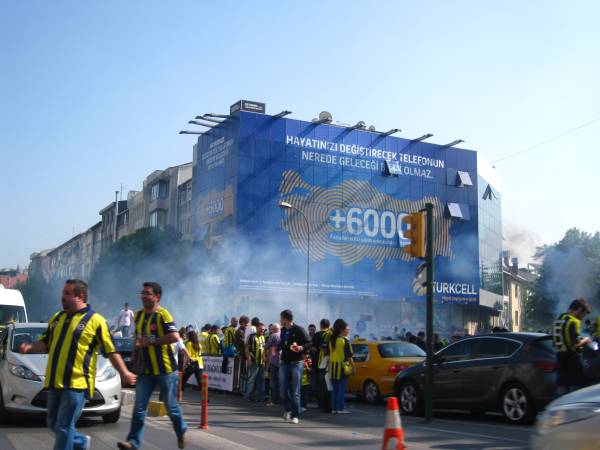
Early Saturday morning, we had sort of forgotten about the game (Cagatay's team is Besiktas, and we don't have the cable channel to watch the Spor Toto games) and made the mistake of heading over to the Asian side for something else. By the time the afternoon arrived, Bagdat Street was packed, with about half of the people in the streets decked out in Fenerbahce gear, waving flags, blowing horns and just generally getting revved up for the match. These photos aren't doing it justice, alas.


We left just as people were starting to walk toward the stadium, probably around 4pm, though the game didn't start until 7, and it took us forever to get to the ferry -- probably because half the road was blocked off for pedestrians.

Then I forgot about it and went to the movies with a friend on the European side, in Nisantasi. We came out around 9:30, when the game had just ended. The score ended up being 0-0, so Galatasaray won the title, and people were just going nuts. We came out and there were all these horns honking, guys shouting and singing, flares going off... Even in the metro, it was a scene. In my car, guys were jumping up and down, banging on the roof, singing at the top of their lungs, and the air was thick with sweat.

When I got home, we watched a bit of the aftermath on TV. It had been agreed that the trophy would be handed to the winning team on the field, which did not go over well with the Fenerbahce fans (who had thrown flares and stormed the field). Apparently it was suggested that Galatasaray be given the trophy in the dressing room (which was rejected) and the prime minister had to intervene in the situation. There is a fantastic photo of the chaos on the field here, on Today's Zaman's website.


Celebrations went on well into the night. One of my coworkers said a Galatasaray fan and a Fenerbahce fan got into a knife fight outside of his building, and a man died in another city when overexicited fans fired a gun up into the air (this is a popular tradition in Turkey; sometimes you see ridiculous stories where brides or grooms or wedding guests get injured). Apparently, 47 fans were arrested during the revelry, and 36 were injured. Pin It

Monday, April 9, 2012

This Week in Turkey: Wrapping up week of 4-2-12

So, what has been happening in Turkey, you ask? A lot of trouble.

One of the biggest pieces of news is that the trial of former President Kenan Evren and former commander of the Air Force Tahsin Sahinkaya -- two of the men responsible for the bloody 1980 coup -- began on Wednesday. "During the period when Evren was at the helm of the country, 650,000 people were detained and 1,683,000 people were blacklisted; 230,000 people were tried in 210,000 cases, the death penalty was sought for 7,000, while 517 were sentenced to the death penalty, and 50 people on death row were executed..." are just a few of the numbers. Evren is now 94 years old and Sahinkaya is 86, and both reportedly in ill health; apparently they will be testifying from home by videoconference.

Turkey is still seeing the fallout from Nevruz, the spring festival celebrated by the country's Kurds that took place three weeks ago. The short version of the story is that the date of Nevruz fell on Wednesday, March 21, but the Kurds wanted to celebrate it the Sunday before; the government said no, claiming that the terrorist PKK group would use it as an occasion to stage attacks. But this exacerbated tensions with the Kurds, who don't feel like they have equal rights in Turkey (for example, they're denied the right to educate their children in the Kurdish language), and people came out for Nevruz that Sunday anyway -- and the celebrations essentially turned into violent demonstrations, both here and in the eastern city of Diyarbakir, which continued for a couple of days. This week, 38 people were detained in Istanbul for their involvement. But more importantly, this week also saw the "birthday" of jailed PKK leader Abdullah Ocalan.

Technically, nothing happened on Ocalan's birthday. But it is a time known for attacks, and there were several bombings or attempted bombing in Istanbul last week. On Monday, for example, a bomb was discovered near the Swissotel but defused, while a bomb exploded that afternoon in another neighborhood near a government office; early Tuesday morning, some percussion bombs went off. I haven't had that anyone claimed responsibility and with everything that's going on with Syria (a number of foreign ministers were in town a week ago Sunday for the Friends of Syria meeting), I think it's hard to say anything for sure.

So, Syria. With the country sitting to the south, Turkey has seen a lot of refugees flooding in, particularly in the last few weeks, and tent cities in the southeastern provinces were set up. But then today, in the first incident of its kind during this crisis, Syrian forces fired across the border into Turkey and hit people at the refugee camp, injuring 5. It doesn't exactly seem like a ceasefire is going to be taking effect tomorrow, does it?
In other sad news, the last official member of the Ottoman dynasty died on Monday at the age of 91.

But I don't want to end on doom and gloom. My favorite story of the week by far was about simit, the ring-shaped bread covered in sesame streets that you often see sold on the street here. Apparently, Barack Obama recently said at the White House that he liked "Greek baklava" -- but the president made a little faux pas because the dessert is both Greek and Turkish, and as you probably know, the two peoples have a fraught history. As a response, the chairman of the İstanbul Simit Tradesmen Chamber decided to try for an international patent for simit, to protect the Turkish food. He was quoted as saying, "We will hold on to our simit and won't allow Greeks to grab our simit." I imagine he also puffed out his chest. Pin It

Sunday, March 11, 2012

This Week in Turkey: Wrapping up week of 3-5-12

I think it's fair to say that the biggest news in Turkey this week -- as it relates to the outside world -- involved the WikiLeaks release of the first Stratfor emails. WikiLeaks has apparently acquired 5 million emails dated between July 2004 and December from the Austin-based company that's been called a "shadow CIA." At least one of the emails deals with the health of Turkish Prime Minster Tayyip Erdogan, saying he has terminal cancer and two years left to live (though I have yet to see a news story that gives the date of this email, it's obviously from no later than December). As I've mentioned before, there were already rumors here that he had cancer, following from two surgeries he's had (in November and last month) on his lower intestine. Previously, everyone has denied that he has cancer, but interestingly, in response to the Stratfor emails, Erdogan issued this week the most undenying denial. On Wednesday, he was quoted as saying: "We are [members of] a party that believes in fate. We are a party that took risks to serve our people. This soul belongs to God. God is the only one who can take it back. We did not and do not surrender to threats. Only God can determine the length of our life. … Those who believe in rumors and speculate on the lifespan of others, for us, are not only daring but insolent as well ." He never says he doesn't have cancer -- it seems to me he just took issue with the idea that a doctor (or an intelligence officer) could accurately predict a date of death. Considering that Turkey is at a crossroads right now and so much rests on Erdogan's shoulders (and charisma), it will be interesting to see what ends up being true.

There was another bomb blast this week, this time near the prime ministry building in Ankara on Monday, and like last week's explosion in Istanbul, little has been said. All that I've really heard about it was that it was a percussion bomb, one person was injured and no group has taken credit for the attack.

As I've already mentioned in another post, it was International Women's Day on Thursday, and Turkey celebrated with gusto!

In our own personal news, our resident garden cat and her kittens seem to be doing well. They're still under the ivy, but I've gone out and taken a peek at them a couple of times. From what I can see (momma mostly sits on top of them), there are just two of them, and they are still sooooo tiny, looking more like mice than kittens. Pin It

Saturday, March 3, 2012

This Week in Turkey: Wrapping up week of 2-27-12

Well, I never did get around to last week's wrap-up. What can I say, work has kept me very, very busy...

There were some big things that happened in Turkey this week but oddly, I don't think they got all that much coverage, at least from what I saw (and keep in mind, I'm only looking at the English-language newspapers here). For example, on Thursday afternoon, a remote-controlled bomb mounted on a motorcycle went off near the headquarters of the ruling party as a police bus was passing, injuring 15 soldiers and a civilian. But I haven't heard anything about it since Thursday -- if some group has claimed responsibility, I haven't seen it.

Likewise, the highly controversial French law that Turkish journalists and politicians have ranted about endlessly was struck down by the French Constitutional Council on Tuesday. The law, passed last month, said that any French national in France denying any events deemed a genocide can be fined 45,000 euros and sentenced to up to a year in jail -- and France had already passed a law deeming the deaths of Armenians in 1915 in eastern Turkey genocide. You'd think Turkey would throw a parade over the striking down of this law but again, barely a peep. Is it because Nicolas Sarkozy says he's going to revise and submit a new bill? The French bill was a big deal here because what happened in 1915 is HIGHLY controversial. Supporters of the argument for genocide say the Ottoman Empire made a deliberate decision to kill the Armenian population and then send whoever remained on a death march to nowhere in a push for nationalism in its final days; most Turks fervently believe that the Turks and Armenians were fighting each other in the east as the Ottoman Empire collapsed, and the deaths (on both sides) were part of the "normal" course of war and battle. Most Turks saw the French bill as a direct accusation, an affront to Turkey and Turkishness.

Tuesday was also the 15th anniversary of the Feb. 28, 1997, "postmodern coup," in which the country's first Islamic prime minister and his partners were forced by the army to resign, which kept Islamists out of the government until the current ruling party came to power in 2001. On Tuesday, there were protests and people made speeches about how it should never happen again, but not much else really happened, from what I heard.

On Thursday, Turkey revealed a symbol (like $) for its currency, the lira, and the prime minster associated the reveal with Turkey's growing financial status. (The country hopes to be one of the world's top 10 economies by 2023.) The Central Bank released an app you can install on your computer so you can use the sign -- Cagatay took a closer look at it and apparently the designer didn't do a good job and the lines are wavy and one of the corners is funky. (I thought those of you who are design-minded might appreciate this.) A Financial Times blog says the new lira sign looks "a little like a pound symbol superimposed on a letter ‘t’." I've also heard people say it looks like the dollar sign, the Euro symbol, the Armenian dram symbol upside down and, best of all, like the letters T and E combined -- which also happen to be the initials of Turkish Prime Minister Tayyip Erdogan. The new symbol is up at the top of this post -- what do you think?

Last but not least, it snowed again this week -- THREE times, including today. The worst part is, everyone thought spring had finally come because it had gotten damp and the feeling in the air had changed. But no... Our neighborhood cat didn't get the memo, apparently, as she's just given birth to her kittens. I'm guessing they're only a few days old, as I've just started to hear them squeaking, out in the garden under the ivy covering the wall -- I haven't seen them yet, as my suspicions were only confirmed this afternoon, but last time, in late spring, she had eight kittens. So hopefully there will be less this go around...  Pin It